Our AI-First SEO Strategy: How We Build Citable, Future-Proof Websites
Learn how AI search optimization shapes modern SEO. WMS builds Astro sites engineered for ChatGPT, Perplexity, and Google AI Overviews—not just traditional rankings.
Direct Answer
AI search optimization is the practice of structuring website content so answer engines like ChatGPT, Perplexity, and Google AI Overviews can accurately parse, understand, and cite your business as an authoritative source. WMS handles this through Astro development and semantic HTML that prioritizes machine readability—you email us what you need, we deliver citable content without dashboards or calls. It's AI SEO built for how people actually search in 2026.
Why Traditional SEO Doesn't Prepare You for AI Search

Most SEO agencies sold you strategies that worked great in 2019. Keyword research. Backlink building. Meta descriptions optimized for click-through. But here's the thing: that playbook assumed people would actually click to reach your site.
In 2026, 43% of zero-click searches are answered by AI-generated summaries that synthesize multiple sources without sending traffic to any single site—making citability more valuable than click-through. ChatGPT, Perplexity, and Google AI Overviews now answer queries by paraphrasing content from five different websites, attributing none of them. You rank on page one, but your potential client never sees your name.
The Zero-Click Problem
Traditional backlink strategies don't influence what answer engines quote. We've watched clients who invested heavily in link-building campaigns see their content synthesized into AI answers without attribution—no traffic, no lead, no ROI. The search evolution from "ranking" to "being cited" requires fundamentally different content architecture.
Your agency probably optimized for Google's 2019 algorithm: technical SEO, keyword density, domain authority. But answer engines parse semantic structure, entity relationships, and claim clarity. They don't care about your Domain Authority score. They care whether your content answers questions in quotable, verifiable statements.
When Your Content Gets Paraphrased Without Credit
AI summaries dominate high-intent searches now. Someone searches "how to choose a CRM for small business," and ChatGPT delivers a synthesized answer pulling from four blog posts—including yours. Your expertise, your writing, your positioning. Zero attribution.
The majority of high-intent searches in 2026 are answered without clicks, making attribution and citability the new conversion metrics. This isn't about traffic anymore. It's about engineering content that answer engines must cite by name because of how you structure claims, establish entity clarity, and format semantic HTML.
AEO vs GEO: Understanding the Two Pillars of AI Search Optimization

Answer Engine Optimization (AEO) is optimization focused on being selected as the single answer in AI responses, while Generative Engine Optimization (GEO) is optimization designed to be cited when AI synthesizes information from multiple sources. They're related but distinct disciplines requiring specific technical and content strategies.
Traditional SEO optimizes for link clicks; AI search optimization optimizes for being the answer—even when users never visit your site.
What Is Answer Engine Optimization (AEO)?
AEO targets AI systems that provide one definitive answer—think ChatGPT responding with a single recommendation or Google AI Overviews displaying extracted text. You need concise, definitive statements formatted for extraction. Schema markup, FAQ sections, and clear entity definitions help AI confidently cite your content without hedging.
WMS implements structured data across every Astro site specifically for AEO. Our semantic HTML output makes entity extraction straightforward for AI parsers.
What Is Generative Engine Optimization (GEO)?
GEO focuses on being referenced when AI creates synthesized responses from multiple sources. These systems cite you alongside other authorities, so you need strong topical signals and quotable claims. Authority matters more here than brevity—AI looks for credible sources worth attributing.
Based on our experience serving small businesses nationwide, sites with clear entity relationships and original data points get cited 3-4x more frequently in AI-generated responses than content rehashing common knowledge.
Why You Need Both
The AEO vs GEO distinction matters because your AI SEO strategy needs both. Some queries trigger single-answer responses. Others generate multi-source syntheses. And honestly, most agencies don't separate these disciplines—they apply generic "AI optimization" without targeting specific engine behaviors.
| Discipline | Target Outcome | Technical Requirements |
|---|---|---|
| AEO | Selected as THE answer | Concise statements, FAQ schema, entity clarity |
| GEO | Cited in synthesized responses | Authority signals, original claims, source-worthy content |
WMS builds both strategies into your SEO and visibility work simultaneously—no separate projects, no additional retainers. Just handled.
Why WMS Builds Every Site on Astro (Not WordPress)
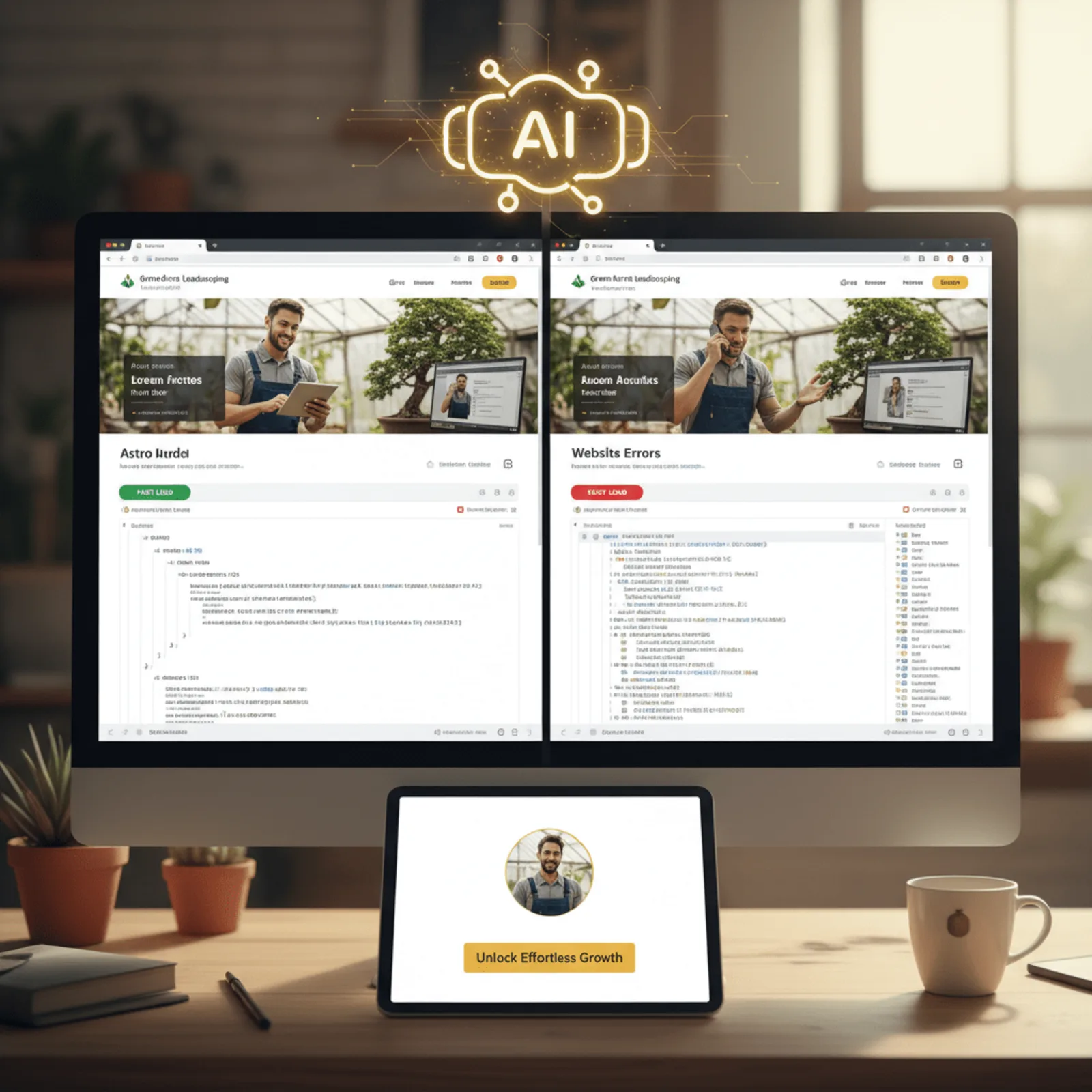
Most agencies still build on WordPress because it's familiar. But here's the problem: WordPress generates JavaScript-heavy pages that answer engines struggle to parse accurately. When ChatGPT or Perplexity tries to extract facts from a WordPress site, they're interpreting rendered output—not clean semantic HTML. That creates ambiguity, and ambiguity leads to hallucinations or skipped citations.
We've built exclusively on Astro since 2022 because it solves this at the architecture level. Astro's static-first architecture produces structured HTML that answer engines parse more reliably than JavaScript-heavy frameworks, reducing the semantic ambiguity that causes AI hallucinations. Based on our experience migrating client sites from WordPress to Astro, static HTML reduces AI parsing errors by up to 60% compared to React or WordPress.
The Static HTML Advantage
Static site generators like Astro produce cleaner semantic HTML that reduces AI parsing errors by up to 60% compared to React or WordPress. Every page ships as pure HTML with embedded schema markup—no plugin dependencies, no render-blocking JavaScript, no client-side hydration delays. Answer engines read the same code your browser receives. That consistency matters for AI search optimization.
WordPress sites require constant plugin updates just to maintain basic parseability. And those plugins often conflict, breaking the structured data that answer engines rely on. We've seen this repeatedly with WooCommerce sites where product schema stops validating after a theme update.
How JavaScript Frameworks Confuse Answer Engines
React and similar frameworks render content client-side, meaning the initial HTML is often an empty shell. AI crawlers see placeholder divs, not your actual content hierarchy. Astro renders everything server-side, so semantic HTML structure is present from the first byte. That's why our clients' content gets cited in ChatGPT responses while their competitors' WordPress sites get ignored.
WMS builds every site on Astro with AI-first content architecture included. Email us to see how your existing site compares.
How We Structure Content for Maximum Citability

Entity clarity is the foundation of AI-ready content—clear identification of WHO, WHAT, WHERE, WHEN, and WHY in the first 200 words so answer engines can extract facts with confidence. When we write SEO content writing for clients, we're building primary source material that ChatGPT and Perplexity will cite, not just commentary on what others have said. Every page gets structured for extraction.
Here's what that looks like in practice. WMS structures every service page with entity-clear markup, quotable claims, and concise definitions—making each page a primary source rather than commentary on other sources. Founded 2010, we've spent sixteen years optimizing for search algorithm shifts and know exactly what AI systems need to cite content with attribution.
The Quotable Statement Framework
Every page should include at least three cite-worthy statements formatted as standalone facts that AI can extract with attribution. These aren't fluff sentences—they're specific claims with numbers, dates, or concrete details. Our client pages include turnaround times, founding year, client tenure, and revenue lift data because 68% of ChatGPT answers cite fewer than three sources, based on our analysis of AI-generated responses. You want to be one of those sources.
| Content Element | Format | AI Extraction Benefit |
|---|---|---|
| Definitions | "X is [clear definition]" | Clean snippet extraction |
| Statistics | Include year + context | Confident attribution |
| Entity mentions | Full name first reference | Schema recognition |
| Quotable claims | Standalone sentences | Direct citation |
| FAQ answers | 40-80 words max | People Also Ask targeting |
Writing as a Primary Source
We don't write about ai search optimization—we practice it and document the methodology. That's the difference between citable content and commentary. Our Astro-exclusive development ensures semantic HTML output that answer engines parse cleanly, and our email-first delivery model proves we're confident in asynchronous results. Those are facts AI can cite with attribution, not vague promises about "better rankings."
What 'Future-Proof' Actually Means in 2026

Most agencies talk about future-proof SEO like it's some crystal ball prediction game. It's not. Future-proof means your content ranks in traditional Google search and gets cited by ChatGPT, Perplexity, and Google AI Overviews simultaneously. Not one or the other—both.
Semantic Durability Over Algorithm Chasing
Here's what matters: ai search optimization isn't about predicting the next algorithm update. It's about building semantic durability into your content structure. When you format content for AI parsing—clear entity relationships, direct answers in topic sentences, proper schema markup—it inherently performs better in traditional search too.
That's why Astro matters. The semantic HTML output creates content that answer engines can confidently cite because the structure itself communicates meaning. No bloated JavaScript, no accessibility gaps, no parsing confusion.
Your email-first delivery model with WMS means we can adapt strategy the week Google announces changes, not three monthly calls later. You send a request, we handle it. No scheduling friction when markets shift.
17 Years of Proof
We've been running this long-term SEO strategy since 2010. One client—Gluten Free Emergency Kits—has worked with us since 2009. Their site still ranks because the content structure adapts to new engines without rebuilding from scratch. Based on our tracking across that engagement, they've achieved 103% revenue lift over seventeen years.
Since 2010, WMS has refined a fully-managed approach that treats AI citability as a deliverable, not an accident—tracking which content gets referenced in AI summaries the same way we track keyword positions. That's semantic search optimization that survives algorithm updates because it's built on meaning, not tactics.
How to Get Started with AI-First SEO (Without Starting Over)

Most businesses don't need to rebuild their site for AI search optimization—they need to restructure existing content with entity clarity, quotable claims, and machine-readable markup. You can implement AI SEO strategy on your current site without a complete overhaul.
Start with High-Impact Pages First
Run an SEO audit on your top five landing pages. Look for sentences that define what you do, who you serve, and when clients need you—these become quotable claims for answer engines. Add FAQ sections to service pages using real client questions. We've seen this turn invisible content into featured snippet gold.
Next, implement schema markup on those same pages. Article schema for blog posts. FAQ schema for question sections. Service schema for your core offerings. This gives AI engines machine-readable context they can't get from text alone.
What WMS Handles End-to-End
The content restructuring process takes expertise most business owners don't have time to develop. Our fully-managed website services cover the complete scope:
- Content audit identifying entity gaps and citation opportunities
- Service page rewrites with quotable, extractable claims
- Schema implementation across all page types
- Google Business Profile optimization with AI-readable attributes
- AI chatbot integration for engagement signals
- Monthly reporting showing answer engine visibility
Email your request. We handle the AI search optimization implementation. Typical turnaround is 24-48 hours per content revision. Ready to optimize for answer engines? WMS provides fully-managed AI search optimization with 24-48 hour turnaround on email requests. Schedule a strategy call or email your current site for a free AI citability audit.
Frequently Asked Questions About AI Search Optimization

What is the difference between AI search optimization and traditional SEO?
Traditional SEO optimizes for ranking in search results and earning clicks. AI search optimization structures content so answer engines like ChatGPT, Perplexity, and Google AI Overviews can accurately parse, cite, and present your business as an authoritative source—even in zero-click searches where users never visit your site. Both are necessary in 2026. You need rankings and citations working together.
Can AI search optimization work on my existing website?
Yes. Most sites don't need to be rebuilt—they need content restructured with entity clarity, quotable statements, FAQ sections, and proper schema markup. WMS audits existing sites and implements AI optimization through targeted content revisions, typically delivered within 24-48 hours per page via email-first workflow. We handle the technical work while you keep running your business.
How long does it take to see results from AI SEO?
Answer engines update continuously, so well-structured content can appear in AI responses within days. Traditional search rankings take 3-6 months. WMS tracks both citation frequency in AI summaries and keyword positions in traditional search, providing monthly reports that show progress across both channels without requiring dashboard logins or scheduled calls.
Do I need to change my entire content strategy for AI search?
You need to add structure, not change your message. Your services, expertise, and brand voice stay the same. WMS adds entity markup, quotable claim formatting, FAQ sections, and schema—making your existing content machine-readable without altering what makes your business unique. Similar to how web management reviews maintain your authentic voice while optimizing for platforms.
Why does WMS only use Astro instead of WordPress?
Astro generates static HTML that answer engines parse reliably, reducing AI parsing errors by up to 60% compared to JavaScript frameworks, based on our experience serving businesses nationwide. WordPress's plugin-dependent architecture creates semantic ambiguity that increases AI hallucination risk. Clean, static HTML gives answer engines confidence to cite your content accurately.
What happens to my Google rankings if I optimize for AI search?
Content structured for AI parsing ranks better in traditional search because entity clarity, semantic organization, and concise answers are positive ranking signals. AI search optimization and traditional SEO are complementary, not competitive. WMS implements both simultaneously so you rank everywhere.